On this page
- 01 | The real breakthrough wasn’t teaching 1,100 people to code
- 02 | Treat agents as software
- 03 | The real barrier isn’t AI. It’s getting non-engineers to work with Git and pull requests
- 04 | A fleet of agents, not one do-everything bot
- 05 | Harvest, tune, repeat — agents get smarter without retraining
- 06 | Automate only what you can trust
These six cards summarize the Anthropic case study How ABC Legal turned every employee into a builder with Claude-managed agents. Figures are current as of July 2026.
01 | The real breakthrough wasn’t teaching 1,100 people to code
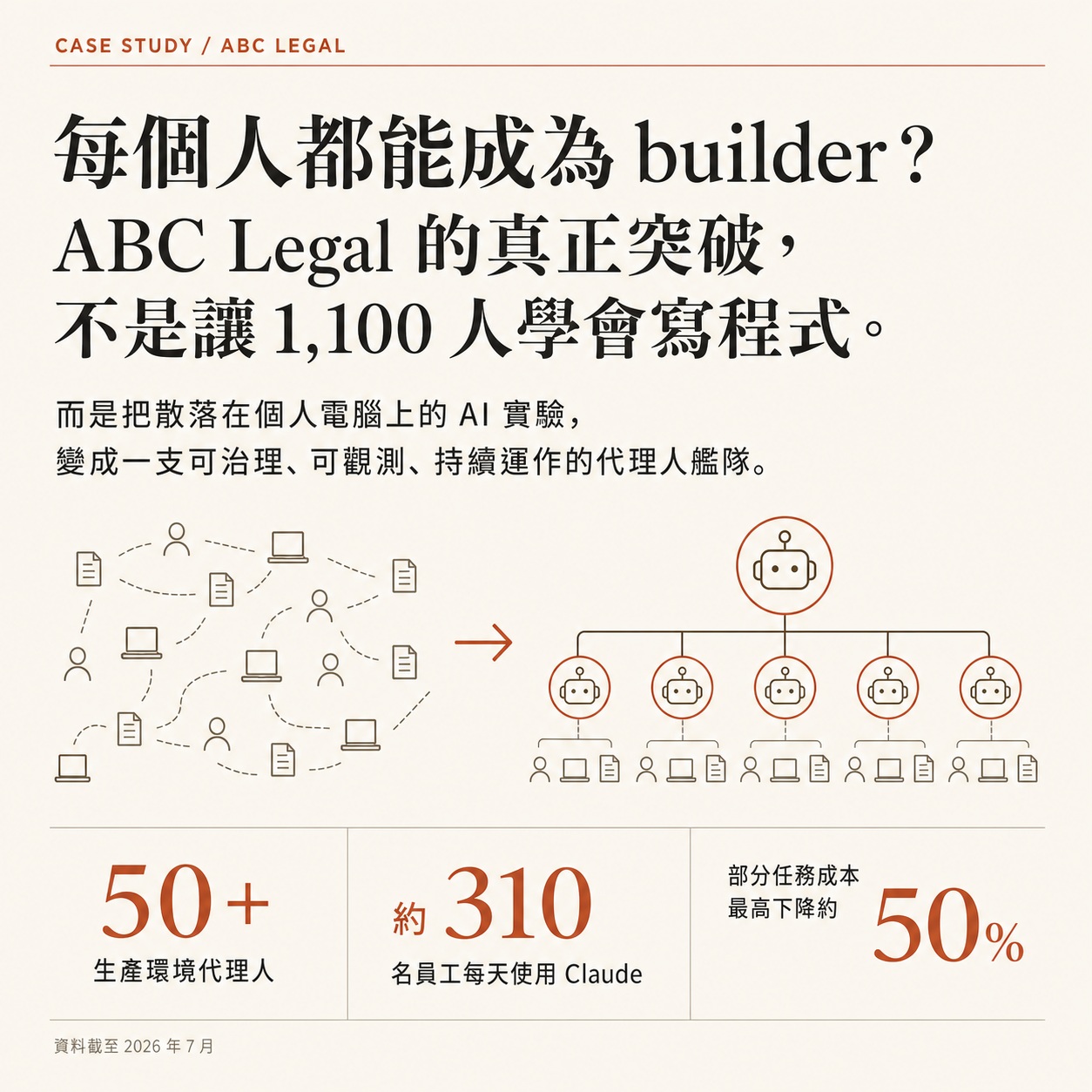
Everyone can be a builder? ABC Legal’s real breakthrough wasn’t teaching 1,100 people to code. It was turning AI experiments scattered across personal laptops into a fleet of agents that can be governed, observed, and kept running.
The left side is the before: a crowd of people, their own laptops, their own documents, loosely joined by dotted lines. The right side is the after: one main agent with five sub-agents hanging off it in layers, each carrying its own people, laptops, and documents.
The figures: 50+ production agents, roughly 310 employees using Claude every day, and costs down by up to about 50% on some tasks.
02 | Treat agents as software
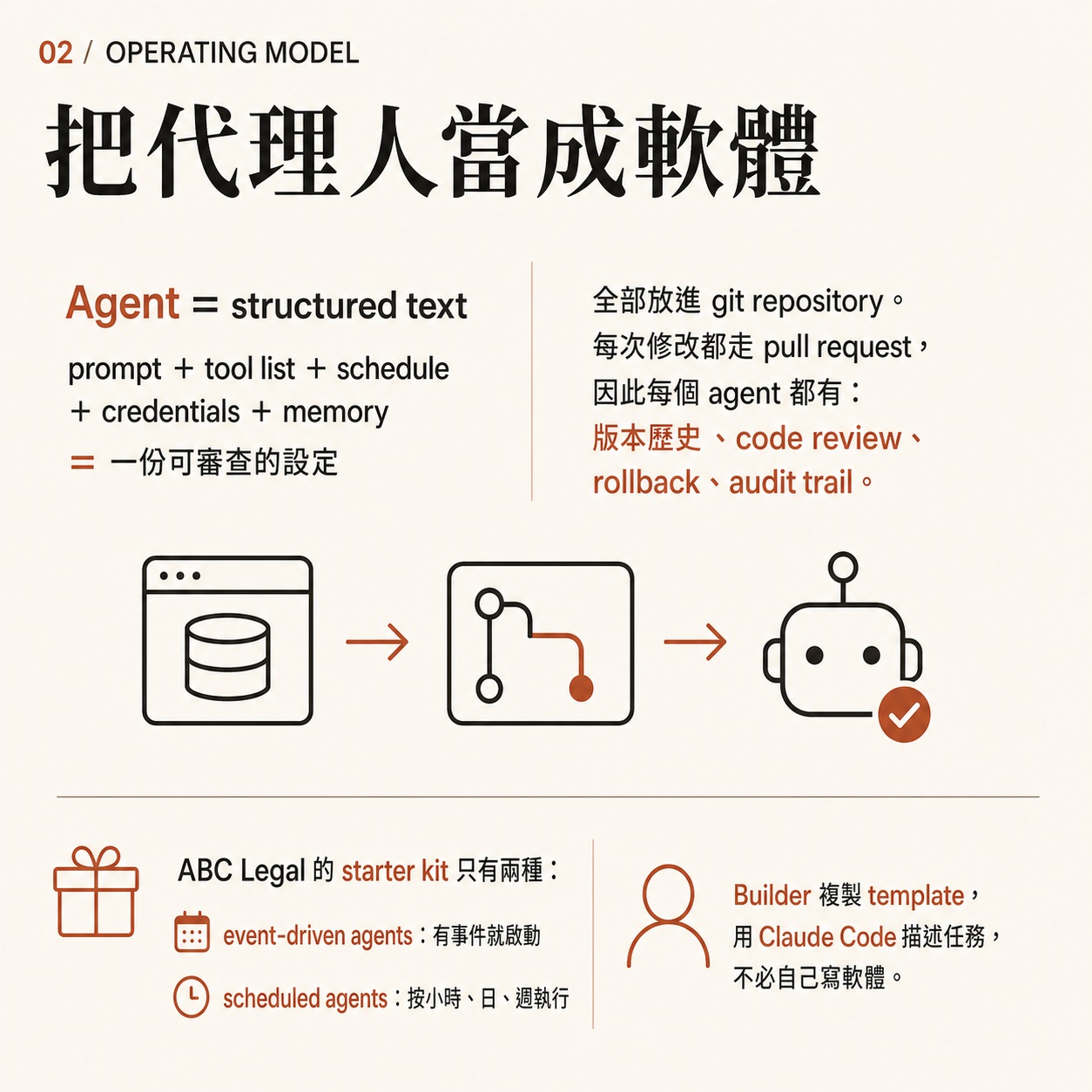
Agent = structured text. Prompt + tool list + schedule + credentials + memory add up to one reviewable configuration.
All of it goes into a git repository. Every change goes through a pull request, so every agent has version history, code review, rollback, and an audit trail.
ABC Legal’s starter kit has only two types: event-driven agents, which fire when an event arrives, and scheduled agents, which run hourly, daily, or weekly. A builder copies a template and describes the task with Claude Code, without writing software.
03 | The real barrier isn’t AI. It’s getting non-engineers to work with Git and pull requests
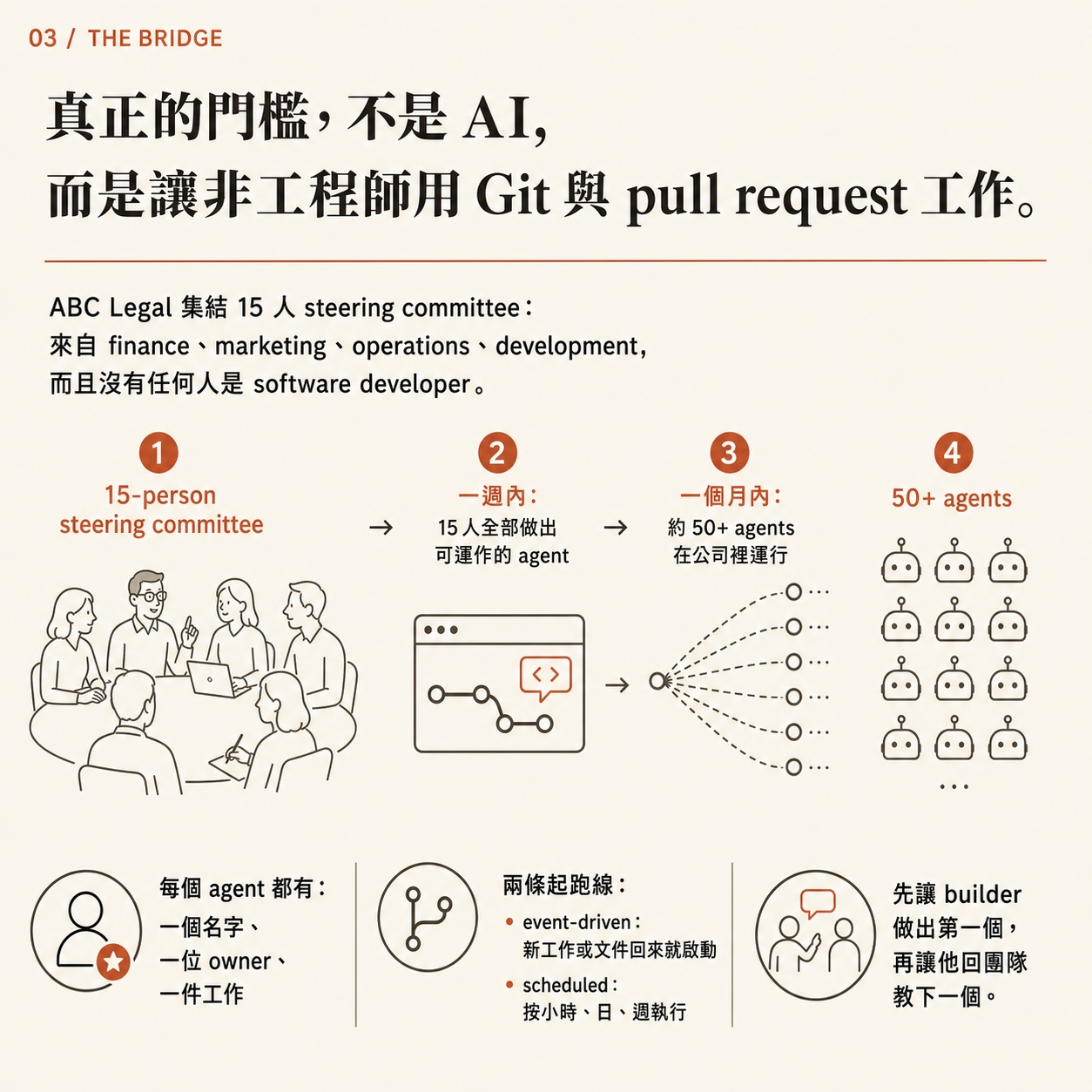
ABC Legal put together a 15-person steering committee drawn from finance, marketing, operations, and development, with not a single software developer among them.
Four steps: a 15-person steering committee, then within one week all 15 had a working agent, then within one month roughly 50+ agents were running across the company, then 50+ agents.
Every agent has a name, an owner, and one job. Two starting lines: event-driven, firing when new work or a document comes back, and scheduled, running hourly, daily, or weekly. Get a builder to make their first one, then send them back to teach the next person on the team.
04 | A fleet of agents, not one do-everything bot
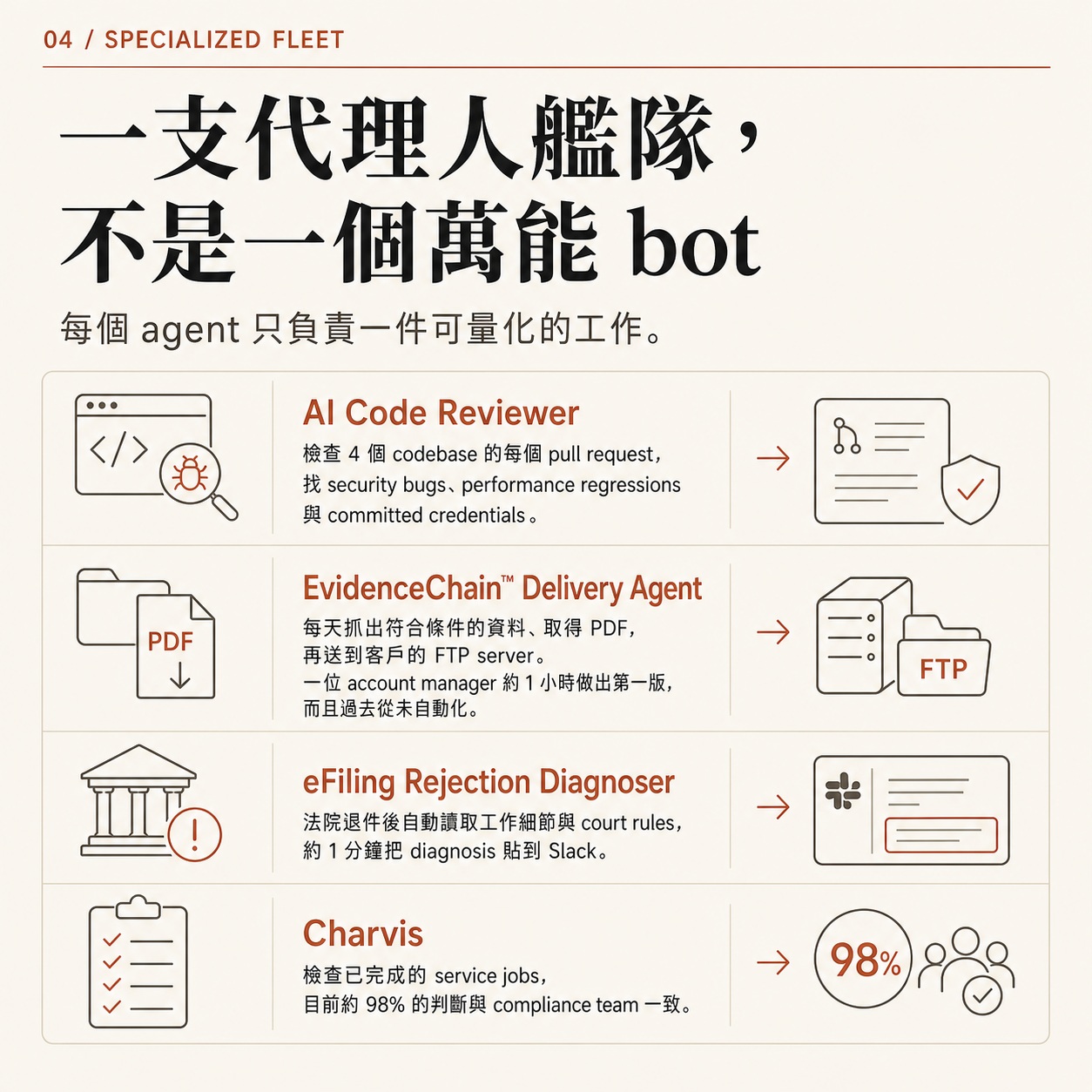
Each agent handles one measurable job.
AI Code Reviewer: checks every pull request across 4 codebases for security bugs, performance regressions, and committed credentials.
EvidenceChain™ Delivery Agent: pulls qualifying records each day, fetches the PDFs, and sends them to the client’s FTP server. One account manager built the first version in about an hour, and this had never been automated before.
eFiling Rejection Diagnoser: after a court rejection, reads the job details and court rules and posts a diagnosis to Slack in about a minute.
Charvis: reviews completed service jobs and currently agrees with the compliance team about 98% of the time.
05 | Harvest, tune, repeat — agents get smarter without retraining
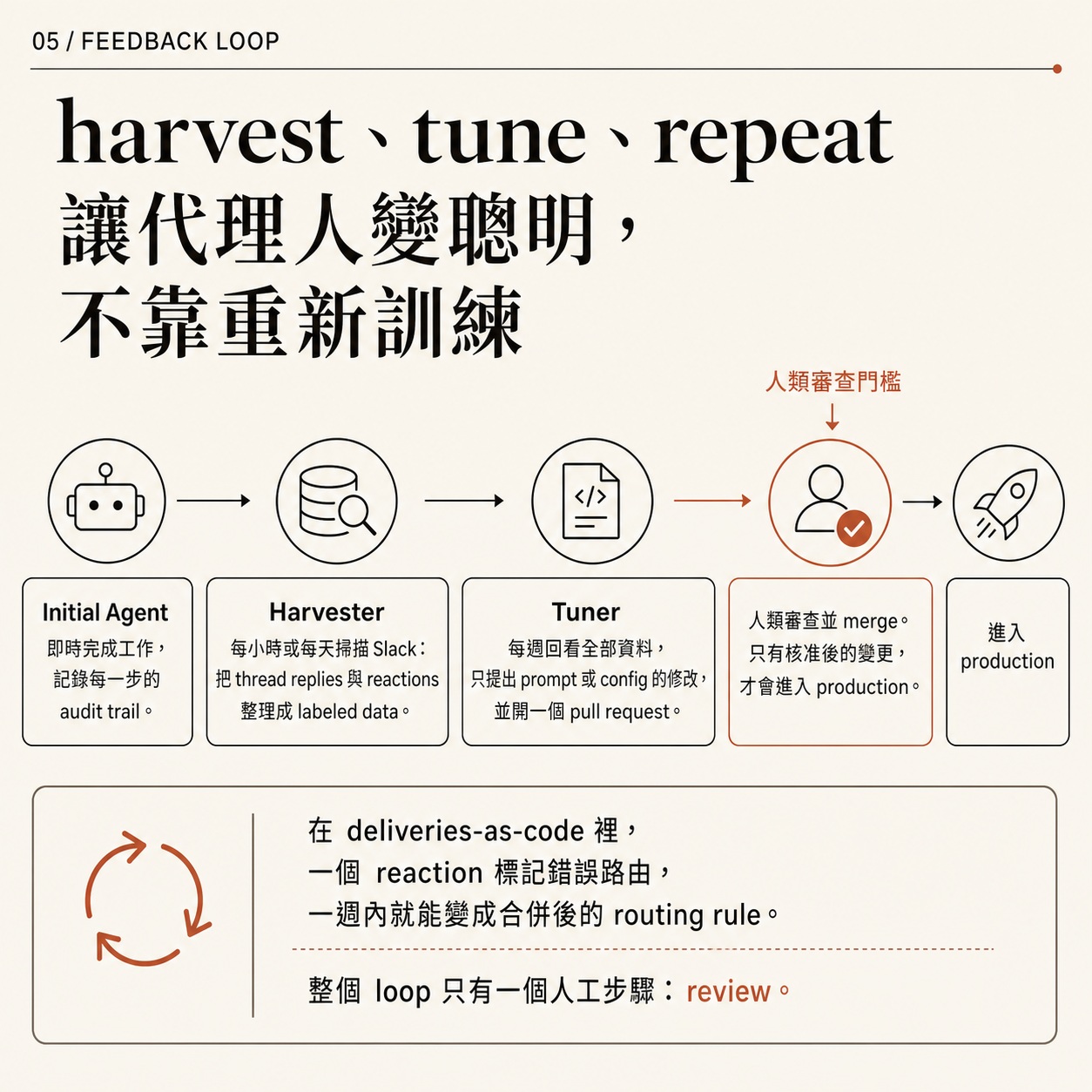
The Initial Agent does the work in real time and records an audit trail of every step. The Harvester scans Slack hourly or daily and turns thread replies and reactions into labeled data. The Tuner reviews all of it weekly, proposes only prompt or config changes, and opens a pull request.
Then comes the one step marked in red across the whole loop: a human reviews and merges. Only approved changes reach production.
Inside deliveries-as-code, a reaction flagging a bad route can become a merged routing rule within a week. The entire loop has one manual step: review.
06 | Automate only what you can trust
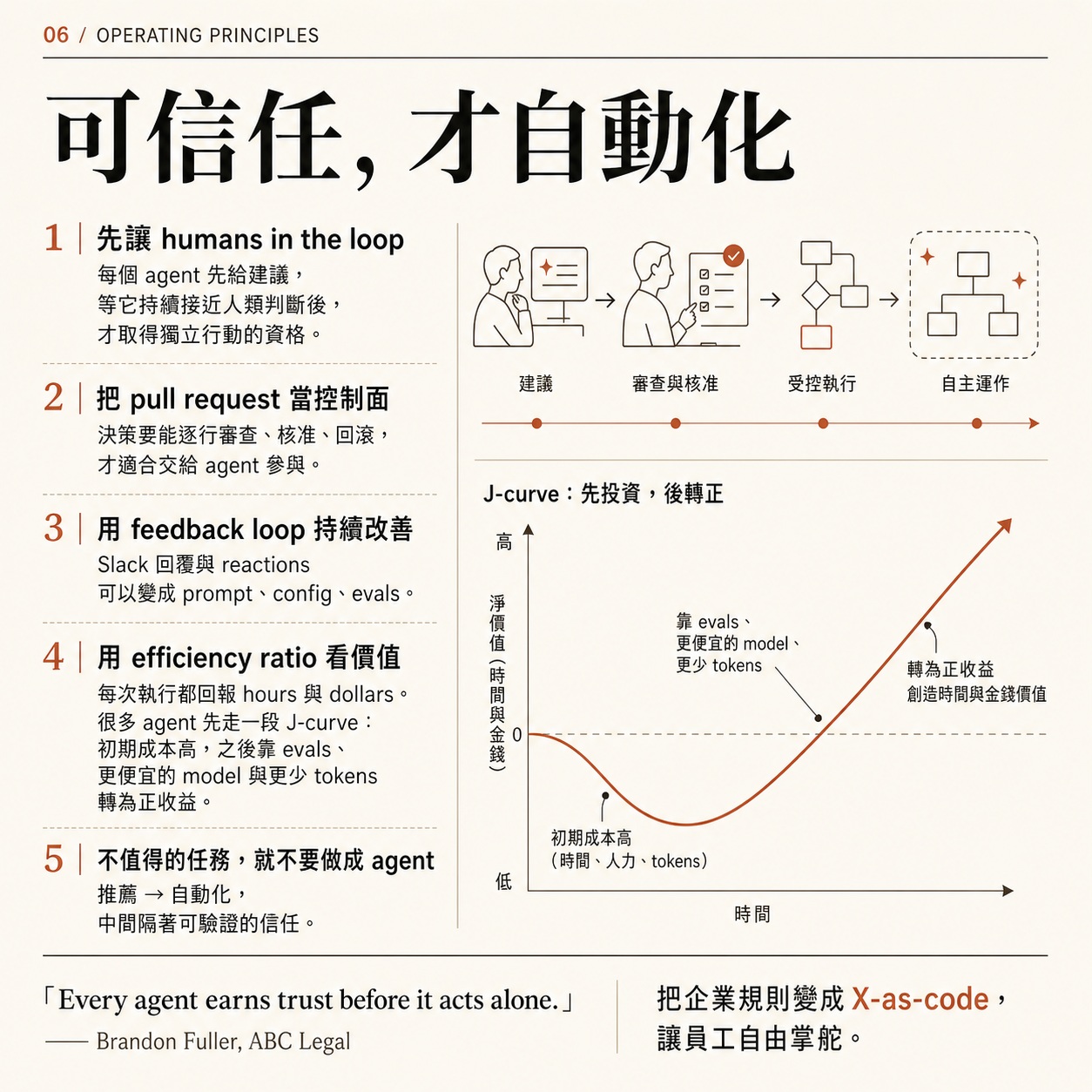
Five operating principles.
One, keep humans in the loop first. Every agent starts by making recommendations, and only earns the right to act on its own once it consistently tracks human judgment.
Two, treat the pull request as the control plane. A decision belongs to an agent only if it can be reviewed line by line, approved, and rolled back.
Three, improve continuously through the feedback loop. Slack replies and reactions can turn into prompts, config, and evals.
Four, measure value with an efficiency ratio. Every run reports hours and dollars. Many agents go through a J-curve first: high cost early, then positive returns through evals, cheaper models, and fewer tokens.
Five, don’t build an agent for a job that isn’t worth it. Between recommendation and automation sits verifiable trust.
The two diagrams on the right show a four-stage axis (recommend, review and approve, controlled execution, autonomous operation) and the J-curve: invest first, turn positive later. High cost up front in time, people, and tokens, then positive returns through evals, cheaper models, and fewer tokens, creating value in both time and money.
At the bottom, a line from Brandon Fuller of ABC Legal: “Every agent earns trust before it acts alone.” Next to it: turn company rules into X-as-code and let employees steer freely.