On this page
I have taught the GMAT (the English-language test for applying to business school) for more than ten years. Recently I handed a batch of recorded student-interview transcripts to an AI and had it build a knowledge base it will look up later when preparing lessons and answering students’ questions. Every statement in it carries my original words and the timestamp in the recording, so it can be checked, and where my own advice contradicts itself over the years, I make the call.
This post covers four things in order: where I was stuck, what I wanted the knowledge base to look like, the numbers from the actual run, and the exact words I said to the AI. At the end there is a starter template you can paste straight to an AI. If you want to build it yourself, the technical details are in the appendix: how it is built.
Want AI working in your own job, not just in demos? See the 3-month 1-on-1 program →
What was bothering me
The first problem was that I had plenty of material, but the AI could not read “how I teach.” I first turned all students’ score reports and interview recordings on my cloud drive into transcripts. My expectation of the AI was simple: the transcripts could fill in my teaching thinking and make the score-report analysis more systematic. The interviews alone came to 202 transcripts, and once converted they were just a pile of files.
The second problem was that reading everything is expensive. I started with the most obvious approach: one AI helper per transcript. After 20 of them, the total was about 2.57 million tokens (the unit AI uses to measure usage), roughly 130,000 per transcript. At that rate, all 202 would cost about 26 million tokens.
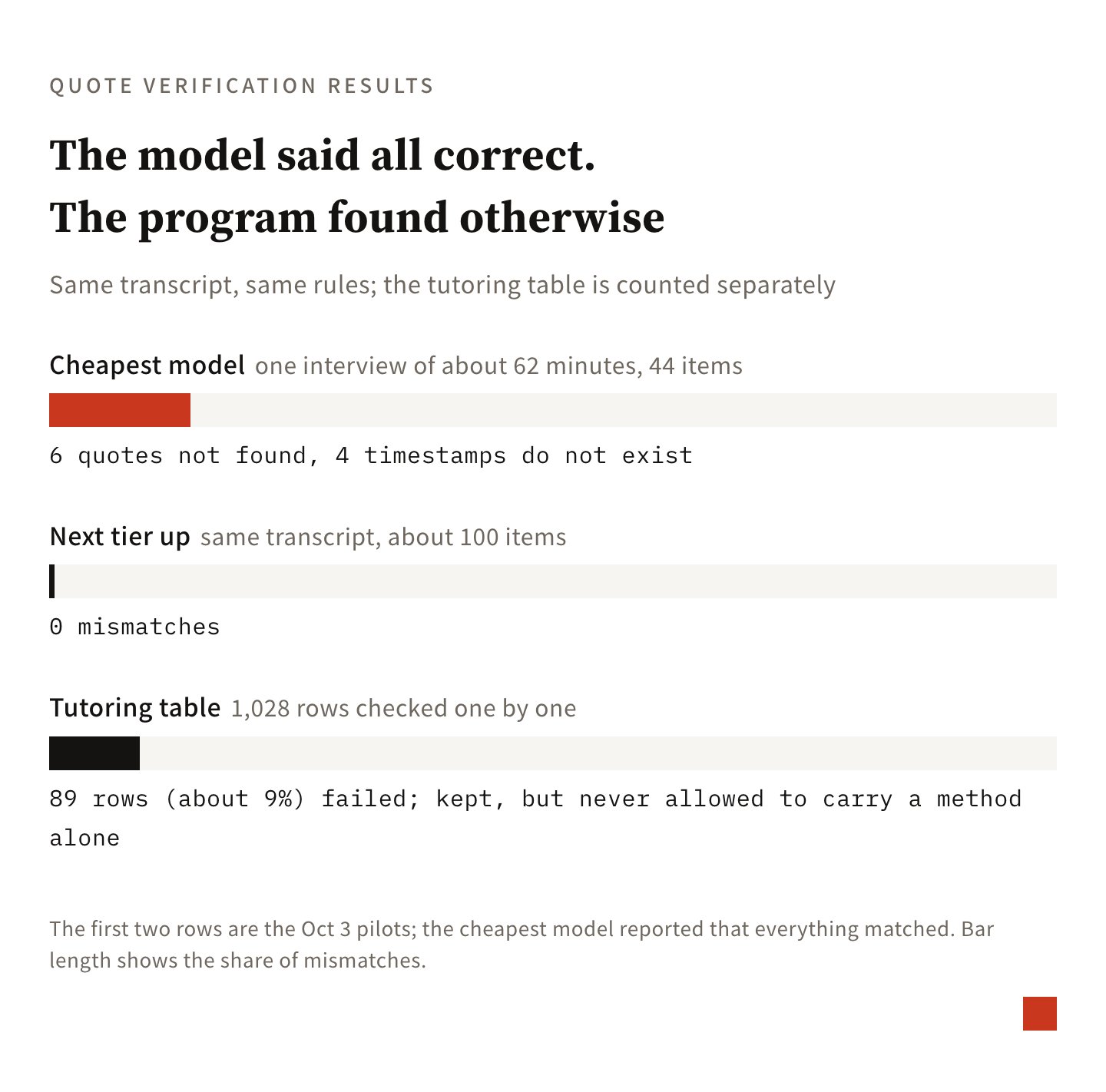
The third problem was that the AI said it was right and I could not trust it. I asked the cheapest AI model to go through one interview of about 62 minutes and pull out my judgments about the student, the practice I recommended, and my estimates, with my original words attached to every item. It returned 44 items and wrote in its report that every quote was copied verbatim from the source. I wrote a small program to compare them. Of the 44 items, 6 quotes could not be found in the transcript, and 4 timestamps did not exist at all.
The fourth problem was that my own advice fights itself. On the same question, the 2024 me and the 2026 me say different things. For how much prep time each section should get, the old advice looked at how many percentile points one more score point buys in each section, and the new advice looks at how many score levels each section is from its “sweet spot.” On whether a question’s position affects the score, the old and new advice say opposite things. The AI just lists everything it sees in the transcripts. It does not know which one is the current me.
What I wanted, and how it changed along the way
I wanted a teaching knowledge base the AI looks up when preparing lessons or answering students, and it had to do three things. First, every statement carries my original words and a timestamp that a program can check. Second, every statement shows how many interviews it appears in, so something said once is not treated as my method. Third, where advice contradicts itself, I make the call, the calls sit at the very top of the document, and dropped old advice is kept only as a record.
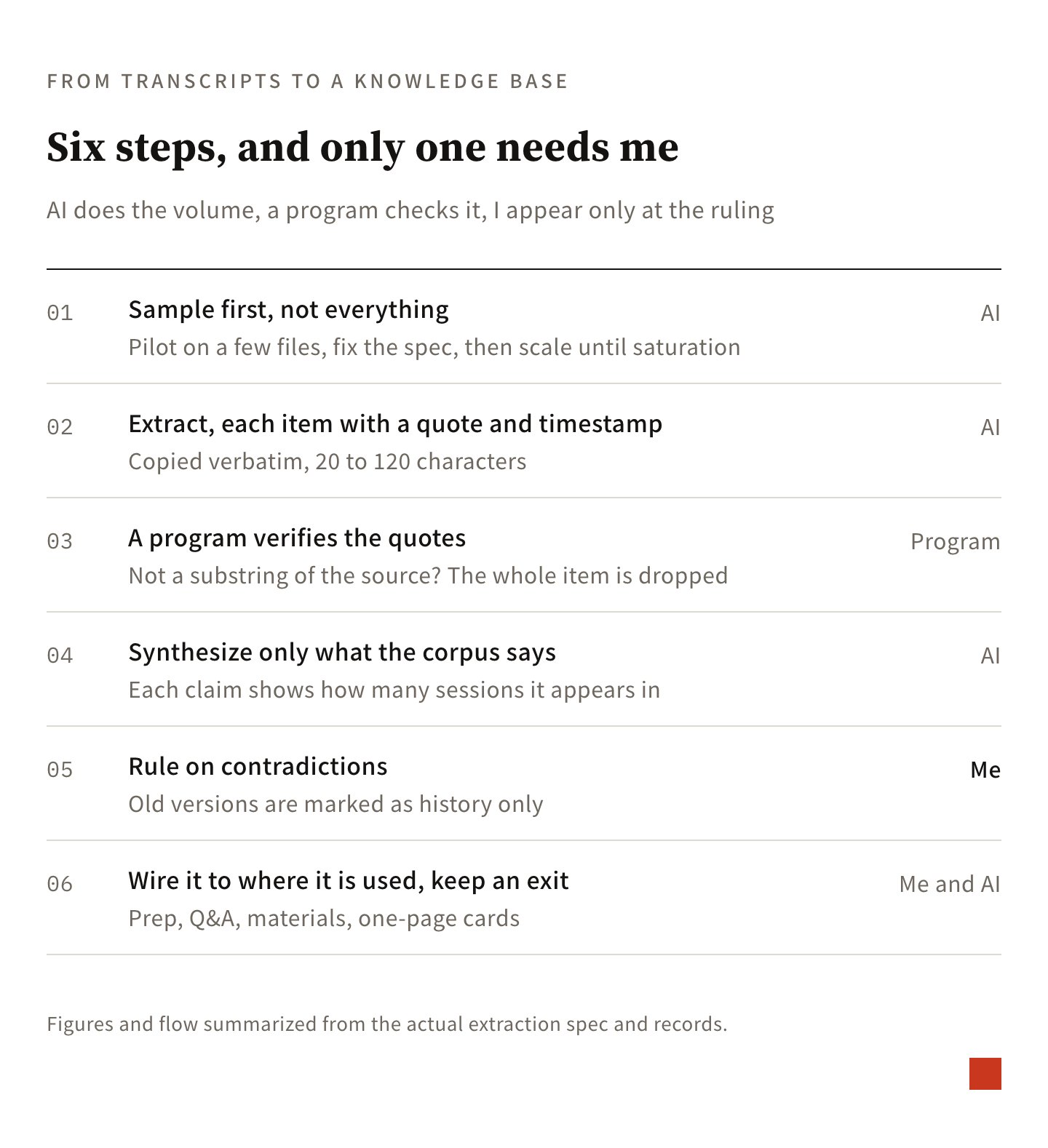
The process went roughly like this, with the key turns concentrated on Oct 3.
Oct 3, morning: a small pilot first. I had three different AI setups follow the same set of extraction rules on the same transcript for comparison. The cheapest model’s result is the 6 wrong items above. So two rules were added: a quote may not join two separate turns of speech into one, and the AI must run a program itself and report the mismatch count the program actually printed, never just say “all correct.”
Oct 3, morning: switch to sampling. After I saw that reading everything would cost 26 million tokens, I called it off and switched to a random sample of 22 interviews, sampling until nothing new turned up. Questions that truly needed every transcript were answered with keyword search instead.
Oct 3: checking against unread interviews, then deciding item by item. The AI grouped what was said in the 22 interviews into 464 groups and wrote an overall summary of my teaching method. I then asked it to draw 12 more interviews it had not read, to see how much the summary covered. After that I went through 22 places where I contradicted myself, in three batches, writing adopt or not adopt with a reason for each.
Oct 7: “when not to use this” gets filled in only when needed. Separately, I had built a table from my one-on-one tutoring transcripts: “where the student gets stuck, and how I handle it.” Every row has a column for “when not to use this move,” which came to about 528 cells, too many for me to review. So the rule became: whichever row a lesson handout uses, I fill in that one while reviewing the handout.
Oct 18: overturning myself once. For guessing on math questions when time runs out, my rule had been “leave at least 0.5 minutes.” I later decided on no lower limit: guess and move on. That rule was one I had settled myself, and I overturned it.
What I measured
The scope is the interview transcripts: a sample of 22 from 202, 12 unread interviews drawn for checking, plus 1,028 rows from the tutoring table. The comparison is the same rules and the same transcript run on different AI models, and the difference before and after the program checks.
A program checking the quotes catches errors the AI says are not there. On the same transcript with the same rules, the cheapest model produced 44 items. The program found 6 quotes that did not match and 4 timestamps that did not exist, while the model said everything matched. The next model up produced about 100 items and the program found 0 mismatches. The tutoring table was bigger: 1,028 rows checked one by one, and 89 (about 9%) failed. They are kept, but none of them can carry a teaching method on its own.
Sampling is cheaper than reading everything, and you can check it afterwards. Reading everything would cost about 26 million tokens, and 22 interviews were enough to produce 464 groups. I checked against 12 unread interviews, and coverage fell between 65% and 80%. The AI doing the work warned me itself that its standard for “covered” was loose, so real coverage may be somewhat lower.
I make the calls on contradictions, and I often say no. There were 22 items in three batches. In the last batch, as things went into the course materials, the AI gave me 10 suggested changes. I answered not adopt on 5, adopt with exceptions on 2, and adopted only 3 outright. Some rules need a criterion first, so I had the AI work backwards from past student cases: “when to start timed practice” drew on 43 cases and “which difficulty to practice for critical reasoning (CR) questions” on 28, 71 cases in total, each with the quote and timestamp. After reading them I changed only one thing: that one was the student’s own slip of the tongue.
After a call, put it where it will actually be used. The 22 calls improved 29 places in the course materials, and were synced to the knowledge base, the website and the handouts. The one-page cards students take into the exam also say when they can be put away: if a student gets 10 questions of one type in a row right within time, with no going back to recheck, the card is put away, and it comes back if the error rate rises again two weeks later.
A problem found. In the score-report analysis on the same material, one AI helper treated the question numbers on the score report as the order of rows in a table, so 25% of the sessions were lined up wrong. After the fix, three conclusions flipped completely. It found this itself on a re-run and reported it on its own. So checking cannot stop at quotes. It also has to check the AI’s assumptions about what the data looks like.
The prompts I gave while building it
Below are the exact words I said to the AI during development, mostly from the same conversation on 10/3. Some phrasing reflects how I normally talk to AI. Before each quote, I explain the background. After each quote, I show how you can adapt it to your own situation.
1. Sample First, Avoid Reading Everything
The AI can dispatch several helpers at once to read files separately (the “subagents” in the quote are these helpers). At the time, it planned to send one helper per transcript. I told it to take a different approach:
You should use a smart approach and avoid dispatching too many subagents. (translated from Chinese)
In your situation: whenever you have a task that involves reading many files, ask the AI first if there is a way to sample them.
2. Ask How Much It Covered
After the AI finishes its first round of sorting, avoid assuming it caught everything accurately. I asked it directly how much ground it covered:
So how much of my teaching methodology does this small batch of transcripts cover right now? Can we spot-check outside this scope? (translated from Chinese)
In your situation: hold off on trusting the results immediately after the AI finishes organizing. Ask it to spot-check against unread materials to see how much the current results actually cover.
3. Save on Checking Too
The AI originally proposed sending six helpers to read one session each. I asked if it could save a bit more:
Spot-check outside the actual scope. Do we really need to dispatch six helpers? Can we just dispatch one to sample six sessions? (translated from Chinese)
In your situation: when an AI approach is too expensive, ask directly if there is a more economical way, such as having one helper handle multiple files.
4. Separate Brainwork from Heavy Lifting
The word “token” here refers to the AI usage unit mentioned earlier. I split the heavy lifting from the thinking when assigning tasks:
You handle directing and verifying. Subagents handle researching or reading files. Use subagents for any execution requiring large amounts of tokens. Meanwhile, you stay responsible for key direction, thinking, and verification, okay? (translated from Chinese)
In your situation: hand off heavy reading tasks to cheaper helpers. Keep the primary AI focused on planning and final checks.
5. Make the Call on Outdated Phrasing
The context here was the earlier contradiction about “how much time each subject requires.” “Percentage slope” was the old phrasing, and “sweet spot” is the new phrasing:
Percentage slope distribution is retired. Everything uses sweet spot now. I agree with the rest. (translated from Chinese)
In your situation: when you see outdated phrasing listed by the AI, tell it directly which item is retired and what to use now. Wrap up the rest with a simple “I agree.”
6. State Your Conditions When Declining
This was my reply to one of the 10 curriculum revision suggestions from the AI. A “quasi-mock exam” refers to a full practice test taken under exact exam conditions before test day:
Decline | I rarely bring up quasi-mock exams lately. I only schedule one week of quasi-mock exams (the second-to-last week before the test) if a student has six weeks. Without six weeks, I remove quasi-mock exams entirely. I agree with everything else. (translated from Chinese)
In your situation: when you disagree, avoid simply saying no. Spell out the exact conditions of what you actually do. That specific rule is what the knowledge base needs.
7. Push Back When There Is Too Much to Review
The AI created a webpage for items requiring my confirmation, packed with checkboxes for me to click page by page. I told it directly to take it back and reorganize:
There are too many review pages. Consolidate and cut them down. I cannot review this many. (translated from Chinese)
In your situation: avoid letting the AI dump every minor detail on you to check off. Tell it to filter and consolidate first, keeping only decisions that truly require your judgment.
8. Put What You Create Where It Will Be Used
The word “spec” in my quote refers to the lesson preparation rules I wrote for the AI:
Have the items you generated connected to our existing specs yet? Without that connection, they will become orphans and never get used. (translated from Chinese)
In your situation: whenever a new document is produced, ask the AI whether it was placed where it will actually be read, such as lesson prep, student Q&A, or the syllabus.
Starter prompt template
You can copy and paste this template directly to an AI that can access your computer folders. Let it handle reading files, calculating statistics, and cross-checking. You only need to review the findings and decide which items to adopt. Replace the bracketed text with your own details:
I want to organize (my teaching transcripts / handouts / article folder) into a teaching knowledge base so you can reference it later when helping me prepare lessons and answer student questions. In the final output, please only summarize the exact words and practices that actually appear in the materials (including my judgments, practices, phrasing, and estimates). Avoid adding your own domain knowledge, and avoid rating anything as good or bad. If you find contradictory statements from different periods or contexts, compile them into a pending decision list for my review. If reading everything will exceed (my budget), switch to sampling instead. Please check the folder first and give me an action plan. I will review it before you begin.Appendix: how it is built
This section is for people who want to build it themselves. The flow follows my actual extraction spec and verification script, and the code is a trimmed version.
Technical terms the main text leaves out
- The “AI helpers” and “small helpers” in the main text are subagents: other AI instances sent out by the AI I am talking to, each reading files and reporting back. The “main thread” in the diagram below is the AI that sends them out.
- The three pilot setups were Claude Haiku, Claude Sonnet, and one especially long transcript. “The cheapest model” is Haiku; “the next model up” is Sonnet.
- The sampling was stratified random sampling; questions that needed the whole corpus were answered with a keyword script.
- The “where the student gets stuck, and how I handle it” table is what I call the sticking-point prescription table internally. Each row is a card, and the “when not to use this move” column is the misuse boundary.
- Besides checking each card’s quote, I ran a misalignment control test, which put the false-match rate at about 6%.
- Checking against unread interviews is an out-of-sample check; the overall summary of my method is a teaching-system document.
Extracting and verifying one transcript
An extraction agent reads a transcript and writes one JSON file, and a verification program then checks each item against the source. The order is:
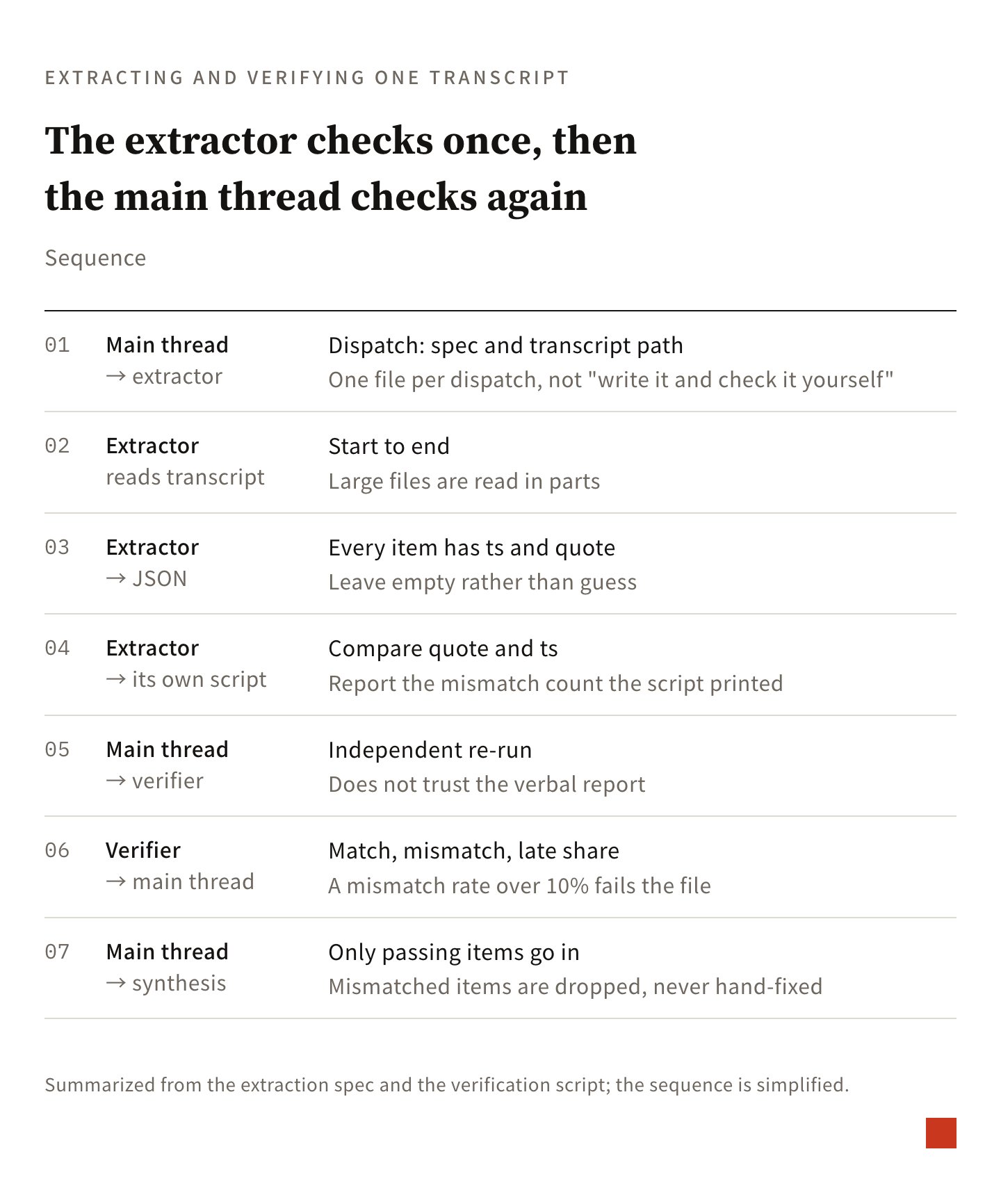
The extraction spec has five iron rules: every item carries a timestamp and a quote; a quote must sit inside a single turn of speech and never join two; anything the transcript does not say is left as an empty array, never guessed; category fields may use only pre-listed values; and the whole file is read before output. Transcripts are speech-recognition output, with misrecognized words and wrong speaker labels, so “who said it” is judged from the content and noted in a field.
The minimal structure of one item is:
{
  "diagnoses": [
    {"section": "CR", "root_cause": "technique_gap",
     "summary": "One plain sentence: where the teacher judged the problem to be",
     "ts": "00:18:16", "quote": "A continuous passage copied verbatim from the transcript"}
  ]
}
The core of the verification program is three checks: whether the quote, with whitespace removed, is a substring of the source with whitespace removed; whether the timestamp exists among the turn headers; and whether the items are spread over the whole session instead of only the first half.
import re

def squash(s):
    return re.sub(r"\s+", "", s)

def check(items, transcript):
    flat = squash(transcript)
    headers = {m.group(1) for m in re.finditer(
        r"^@\S+\s+(\d\d:\d\d:\d\d)\s*$", transcript, re.M)}
    bad_quote = [i for i in items if squash(i["quote"]) not in flat]
    bad_ts = [i for i in items if i["ts"] not in headers]
    return len(items), len(bad_quote), len(bad_ts)
The real script also checks whether a category field uses a value outside the list, and the share of timestamps past 60% of the session (below 15% is read as having read only the first half). A file fails if the mismatch rate exceeds 10%, if there is an enum error, or if the late share is too low. The spec also says that in the formal pipeline an item with a mismatched quote is dropped whole.
How contradictions are ruled on
The synthesis step does one thing: group the versions found in the corpus and record how many sessions each appears in, plus the earliest and latest dates. When one topic has different versions, it does not pick one. It lists them all.
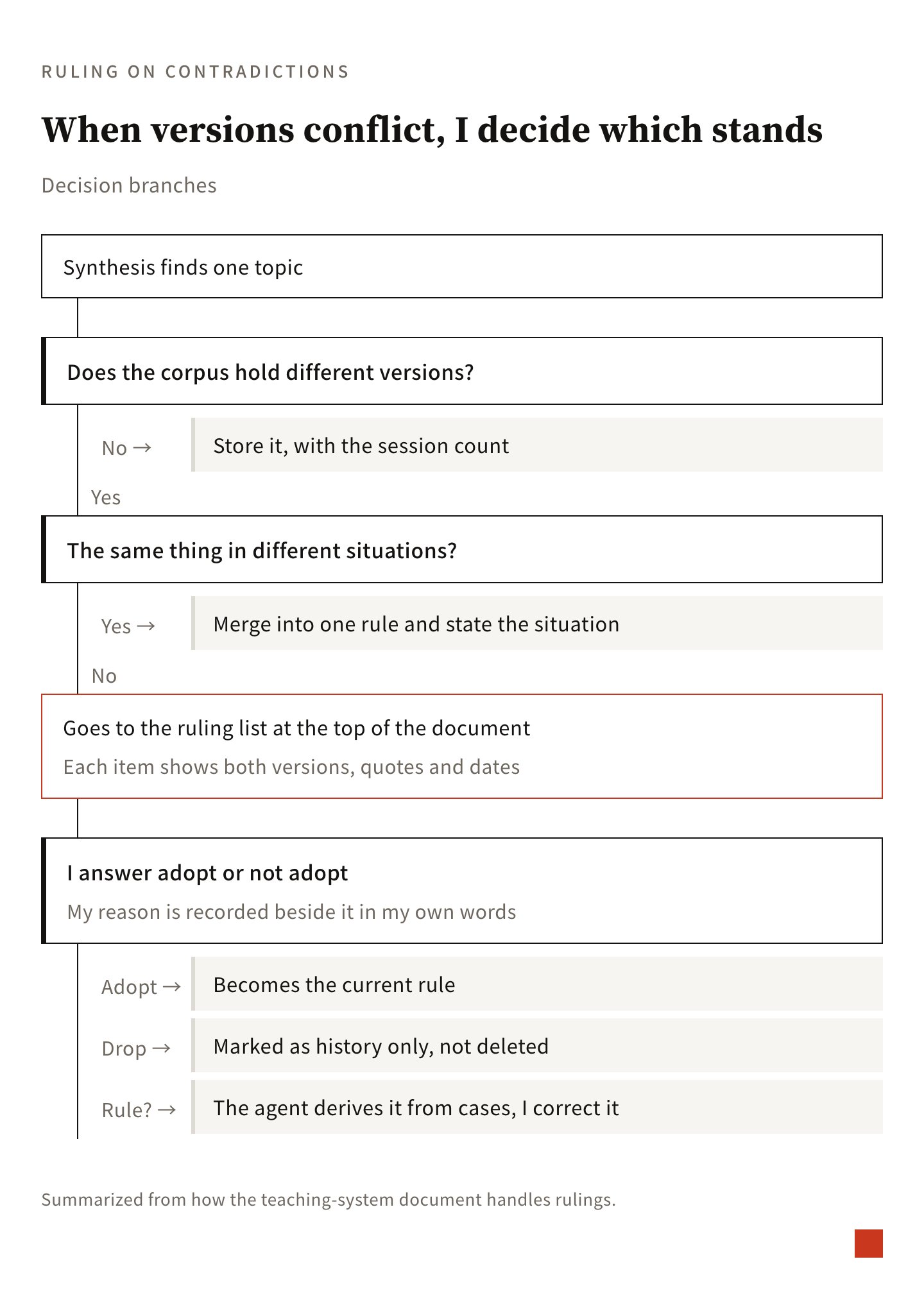
For decision rules that need a criterion (for example when to start timing), I first ask an agent to derive it from cases. Each case is one row with the student’s data at the time, my prescription, the quote and the timestamp, so what I review is 71 rows of evidence.
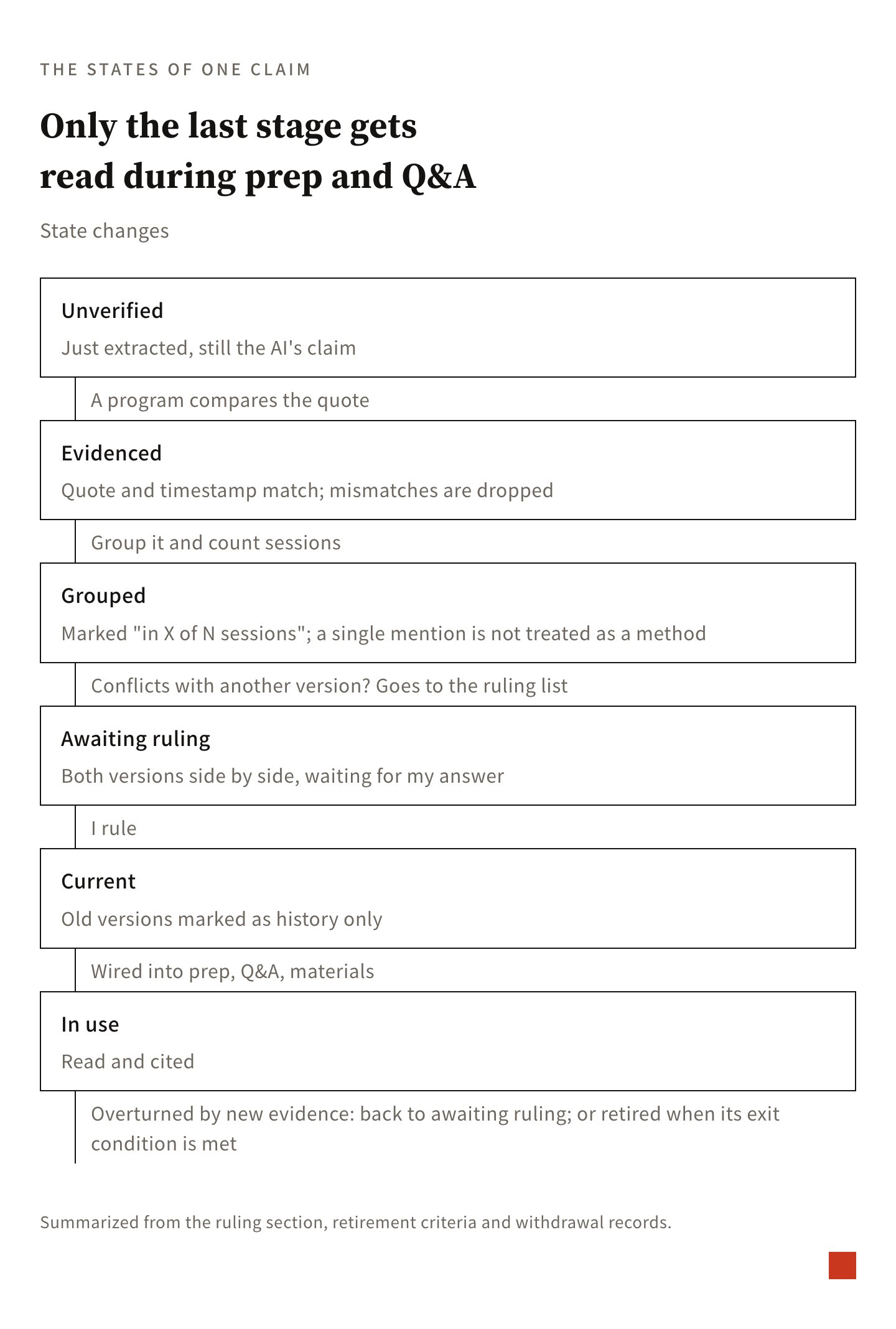
The states of one claim
Each claim in the knowledge base has a state, and only a claim that reaches the last stage is read during lesson prep and Q&A.
Build it yourself: the minimal version
- An extraction spec in which every item has a quote and a timestamp.
- A comparison program that drops any item whose quote is not a substring of the source.
- A pilot on one to three files, then scale up once the spec is fixed; sample to saturation instead of running everything.
- Synthesis that writes only what the corpus contains, with a session count on every claim.
- A ruling list where you answer only adopt or not adopt, and write the reason.
That’s it.